
Many Christian women live with a secret struggle. They love Jesus. They serve in their churches. They care for their families. They know what Scripture says about grace, forgiveness, and freedom.
Yet when it comes to food, they feel trapped.
They find themselves eating when they are stressed, lonely, overwhelmed, or hurt. Afterwards, they are flooded with guilt and shame. They promise themselves they will do better tomorrow. They pray harder, try a new diet that is sure to end this “crazy eating,” and renew their commitment to self-control.
But despite their best efforts, the cycle continues.
If this sounds familiar, I want you to know something important: The problem may not be a lack of willpower (it rarely is). The problem may be shame.
The Cycle Most Women Don’t Recognize
Many women assume emotional eating begins with food. In reality, food is often the symptom, not the root issue.
The cycle frequently looks something like this:
A difficult emotion surfaces—stress, loneliness, anxiety, rejection, disappointment, or grief. Instead of processing the emotion, food becomes a source of comfort, distraction, or relief.
After eating, guilt appears. Then guilt quickly turns into shame.
The woman begins to think:
“What’s wrong with me?”
“Why can’t I get this under control?”
“A good Christian shouldn’t struggle like this.”
“God must be disappointed in me.”
These thoughts create even more emotional pain. Since the pain feels unbearable, she turns to food again for comfort.
The cycle repeats.
What began as an attempt to soothe pain becomes a source of even greater shame.
Yet Scripture reminds us that God sees beyond our behaviours and looks at the heart (1 Samuel 16:7). He understands the deeper struggles, wounds, and burdens we carry.
The Difference Between Guilt and Shame
Understanding the difference between guilt and shame is crucial.
Guilt says: “I made a mistake.”
Shame says: “I am a mistake.”
Guilt points to a behaviour. Shame attacks your identity.
The enemy loves shame because it keeps us hidden. It convinces us that if others knew our struggles, they would reject us. It whispers that we are failures, hypocrites, or disappointments.
But shame was never God’s tool for transformation.
Throughout Scripture, conviction leads people toward God. Shame drives them away.
When Adam and Eve sinned, their first response was to hide. “Then the eyes of both were opened…and they hid themselves from the presence of the Lord God” (Genesis 3:7-8).
Shame always urges us into hiding. Yet God’s response was to pursue them.
The same is true today.
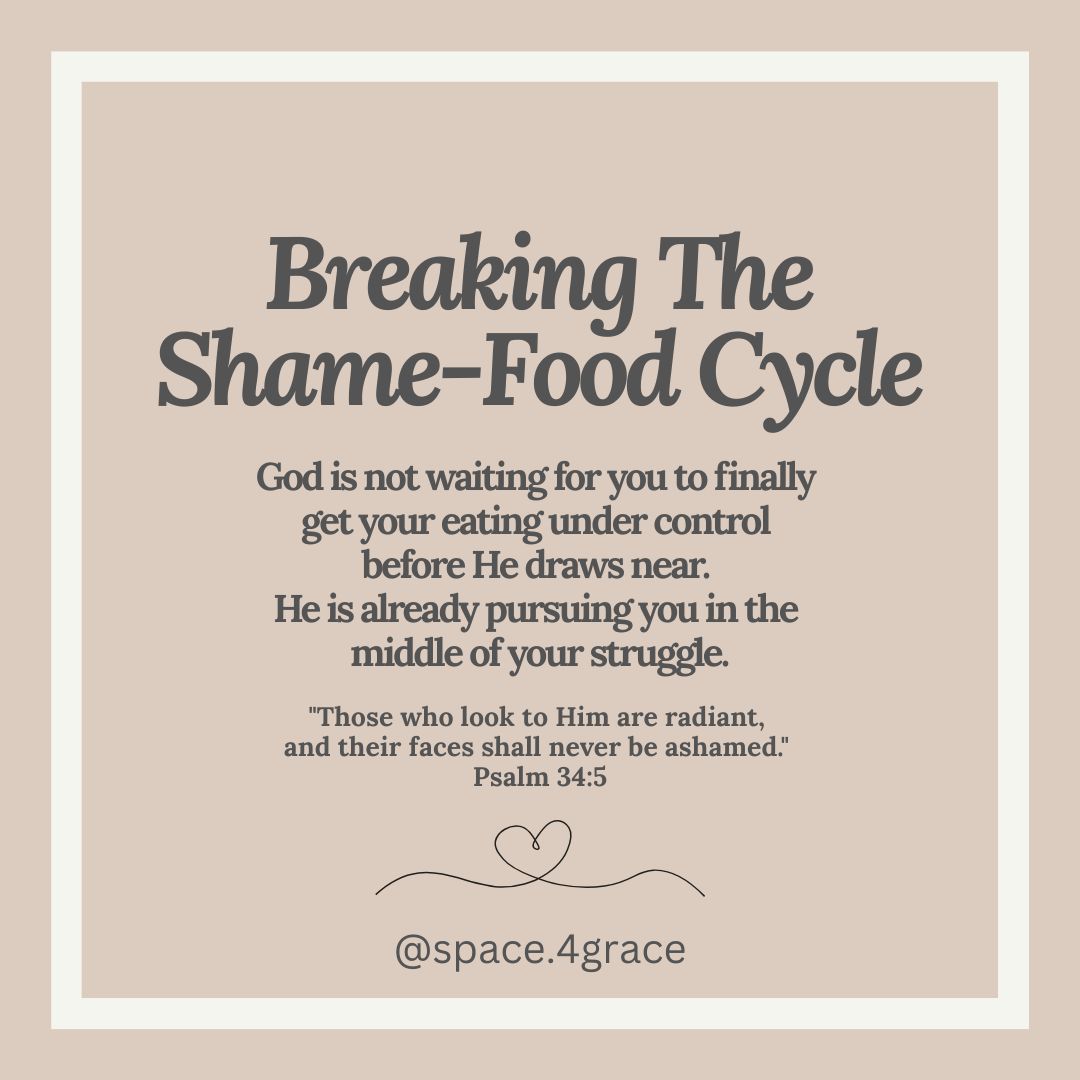
God is not waiting for you to finally get your eating under control before He draws near. He is already pursuing you in the middle of your struggle.
In fact, Romans 8:1 offers this beautiful promise:
“There is therefore now no condemnation for those who are in Christ Jesus.”
Notice that Paul doesn’t say there is no condemnation after you’ve fixed yourself. There is no condemnation because you belong to Christ.
Why Christian Women Are Particularly Vulnerable to Shame
Many Christian women carry expectations that make shame especially powerful. They believe they should always be grateful, joyful, patient, and self-controlled.
When difficult emotions arise, they may feel guilty about having those emotions in the first place. Instead of acknowledging hurt, anger, fear, or loneliness, they try to push those feelings away. But emotions don’t disappear when they are ignored. They simply find another outlet. For many women, food becomes that outlet.
Food doesn’t judge.
Food doesn’t ask questions.
Food offers temporary comfort.
The problem is that food was never designed to carry the weight of our emotional pain. Only God can do that.
The psalmist writes: “Pour out your heart before Him; God is a refuge for us” (Psalm 62:8).
God invites us to bring our emotions to Him honestly, not to suppress them or pretend they don’t exist. Yet many women discover that simply telling themselves to “trust God more” doesn’t resolve the deeper wounds driving their behaviour.
There may be unresolved grief, childhood wounds, rejection, trauma, perfectionism, or chronic stress beneath the surface. These deeper issues deserve compassionate attention, not condemnation.
Psalm 34:18 reminds us: “The Lord is near to the broken-hearted and saves the crushed in spirit.”
God’s response to wounded hearts is not shame. It is compassionate presence.
Jesus Never Led With Shame
One of the most beautiful truths in the Gospels is that Jesus consistently moved toward people carrying shame. Jesus drew near to those whom society had shunned or given up on.
He approached the woman at the well (John 4).
He welcomed the woman caught in adultery (John 8:1-11).
He dined with tax collectors and sinners (Matthew 9:10-17).
He restored Peter after his denial (John 21:15-19).
Again and again, Jesus demonstrated that transformation happens in the context of grace. He spoke truth, but He never weaponized shame. John 1:14 states that Jesus became flesh and was full of grace and truth.
Consider His words to the woman caught in adultery:
“Neither do I condemn you; go, and from now on sin no more” (John 8:11).
Grace came before transformation.
Many women have spent years trying to shame themselves into changing. Perhaps you’ve told yourself:
“I’m disgusting.”
“I have no self-control.”
“I’ll never change.”
Yet despite years of self-criticism, the struggle persists. What if shame isn’t motivating change? What if it’s actually preventing it?
Real healing begins when we bring our struggles into the light and allow God’s grace to meet us there.
As 1 John 1:7 says: “But if we walk in the light, as He is in the light, we have fellowship with one another, and the blood of Jesus His Son cleanses us from all sin.”
Healing grows where honesty replaces hiding.
What Freedom Can Look Like
Freedom from emotional eating is about far more than changing eating habits.
- It involves learning to recognize your emotions without fearing them.
- It means learning to understand the deeper wounds beneath the behaviours.
- It means replacing self-condemnation with truth – The truth of who you are because of what Jesus has done for you!
- It means discovering that your worth was never determined by a number on a scale, a clothing size, or your ability to “eat perfectly.”
Your identity has already been settled in Christ. It is not tied to what you have or have not done but is solely based on what Christ has done (Ephesians 2:1-10)!
Ephesians 2:10 says: “For we are His workmanship, created in Christ Jesus for good works.”
Most importantly, freedom means experiencing the love of Christ in the places where you have felt the most shame.
Healing is often not a straight line. There may be setbacks and difficult days. But freedom becomes possible when shame loses its power.
Hebrews 12:2 tells us that Jesus endured the cross, “despising the shame.” Through His sacrifice, He broke shame’s ultimate hold over us.
A Gentle Invitation
If you’ve been caught in the cycle of emotional eating and shame, I want to encourage you: You are not weak. You are not alone. You are not a failure. You are not beyond God’s grace.
Your struggle with food may be revealing deeper places in your heart that need healing, care, and compassion. You do not have to walk that journey alone.
Jesus extends this invitation to weary and burdened people:
“Come to me, all who labour and are heavy laden, and I will give you rest” (Matthew 11:28).
If you’re ready to explore the roots beneath your relationship with food and begin moving toward lasting freedom, coaching can provide a safe space to uncover what’s driving the cycle and invite God’s healing into those deeper places.
Freedom is possible—not through more shame, but through grace, truth, and the transforming love of Christ.
“Those who look to Him are radiant, and their faces shall never be ashamed” (Psalm 34:5).
If this article resonated with you, I’d love to connect. I offer faith-integrated coaching for Christian women who are ready to move beyond food struggles and uncover the deeper roots of shame, trauma, and emotional pain. Click here to schedule a complimentary discovery call or send an email to info@space4grace.ca to learn how healing and freedom are possible for you.