
Recovery from an eating disorder (or any mental health diagnosis) is hard. Not one aspect of this journey would be considered easy, and much of it is anything but fun. Quite often, the women I meet with who are actively pursuing recovery become discouraged, weary from the battle, and at times, ready to give up.
“Is it worth it?” they ask.
I asked the same question.
Such a great deal of effort toward an unknown. The women I work with, like me, have lived since their early teen years (some even younger) with negative thoughts about food, their bodies, and their worth. This mindset is all they have known!
Recognizing the lies we have believed for so long for what they are — lies — is hard, humbling, and even heartbreaking. I remember a season when, as soon as I had come to terms with a lie I had believed about myself, replaced it with truth, and started living in light of that truth, another lie would surface. The roots of an eating disorder run deep and are often entangled.
I mentioned the unknown. The goal of a life without an eating disorder can feel ambiguous at first. Little by little, the eating disorder and the beliefs and behaviours that accompany it become normal. This way of life becomes the default mode, and we begin to believe it provides safety and security simply because it is familiar.
When someone has lived most of the life they can remember with eating-disorder thoughts, it can be incredibly difficult to imagine life any other way, let alone a better way.
The tendency to want to “throw in the towel” is understandable. Many women living with anorexia or bulimia would say they are managing. I was even diagnosed as a “high-functioning anorexic.”
What? It sounds like an oxymoron, but yes, our bodies are incredible. We are indeed “fearfully and wonderfully made” (Psalm 139:14)!
Our all-wise Creator gave us resilient bodies that can withstand a lot. But living continuously on the brink of collapse, with our “check engine” light on, is not what our loving Creator intended for us. This God-given resilience is not a licence to do whatever we want, nor does it excuse any sort of abuse.
So, how do we keep moving forward when it seems easier to revert to default mode? How do we rise above feelings of despair? How do we continue to put one foot in front of the other when it seems impossible?
Recently, I read the first four chapters of 2 Corinthians. I read slowly and then reread the passages. These chapters are packed with both encouragement and challenge. Encouragement as they remind us of who God is and what He has done for us, and challenge as they call us to live differently for the sake and glory of Christ.
Later that day, I had the opportunity to unpack some of these truths with a friend. They were truths that encouraged us both when the tasks ahead seemed overwhelming.
Here are a few key verses and truths that I have been studying and returning to.
Our Sufficiency Comes From God
One thing I appreciate about this passage (and the entire Bible) is the degree of honesty with which the biblical authors, inspired by God’s Spirit, write.
The Apostle Paul, whom many of us might consider a “super-hero of Christianity,” readily acknowledges his weaknesses. He recognizes that he is not competent in his own strength or abilities to do anything of significance. He doesn’t say this from a place of self-loathing. Rather, he closes this thought by reminding himself and his readers that his ability to do anything comes from God!
Paul knew who his God was. He knew and remembered that Jesus had rescued him from sin, forgiven him, and made him right with God — not because Paul was great or impressive, but because Jesus loved him and gave Himself up for him (Galatians 2:20).
Paul was who he was solely because of the grace of God. He was saved by grace alone, through faith alone, in Christ alone (Ephesians 2:8-9). He was saved by grace and sustained by grace. That is the power of the Gospel — the power of God for salvation to everyone who believes (Romans 1:16-17).
Paul understood that his value was not found in how impressive he was, how much he produced or achieved, or even in his abilities. His value was settled in the love and life of Christ.
Strict adherence to the law kills, but the Spirit brings life (2 Corinthians 3:6). The pressure to be good and to adhere perfectly to a moral code kills us. This endless striving drains and discourages us.
However, a life of obedience, empowered and equipped by the Spirit of God, leads to a life of genuine freedom (2 Corinthians 3:6,17).
What a difference it makes when we move from striving in our own strength to depending on the sufficiency of God!
We Do Not Lose Heart
God’s mercy and grace give us reason not to lose heart.
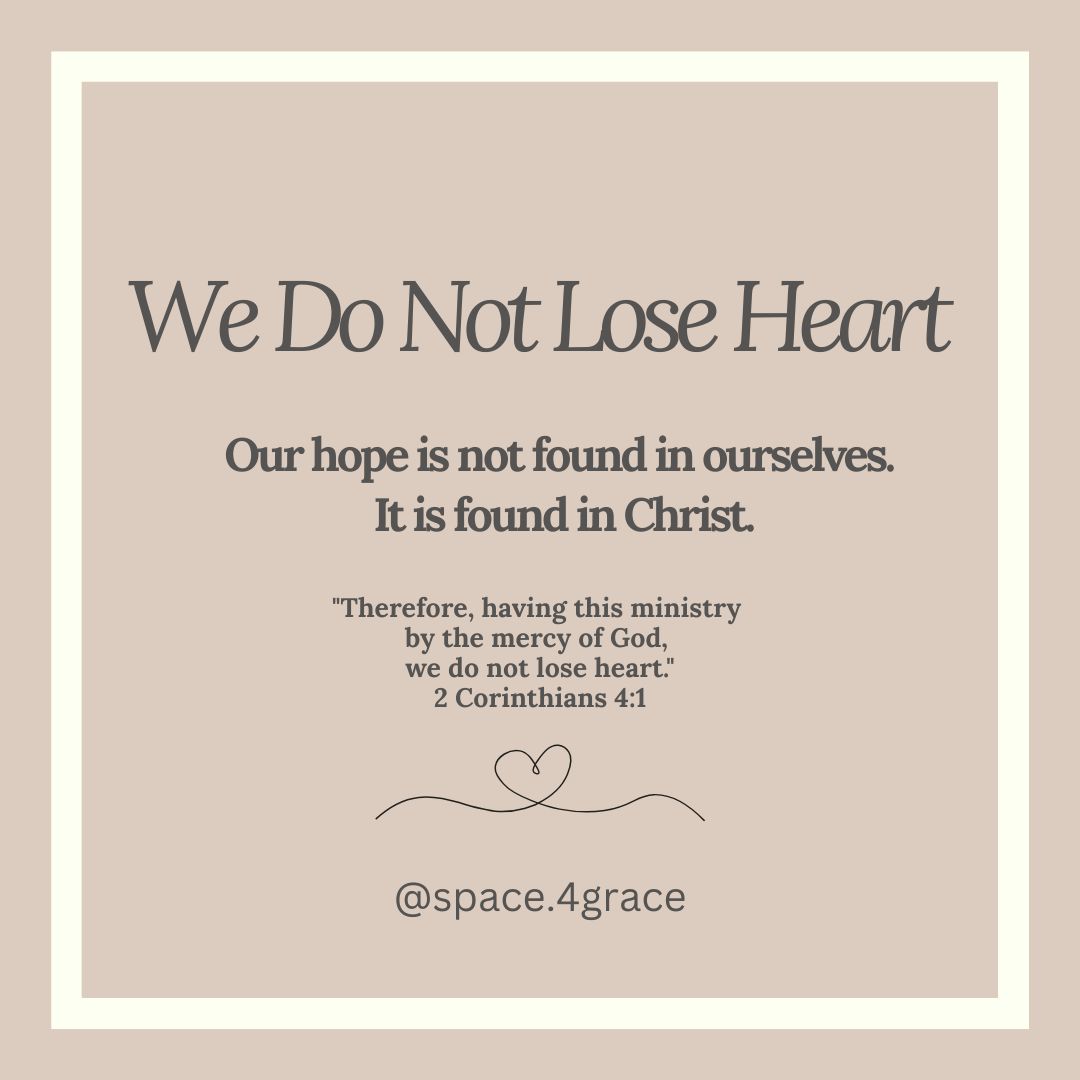
Because we have received mercy, “we do not lose heart” (2 Corinthians 4:1).
Each of us is human. We are earthen vessels — clay jars, or cracked pots, as Paul describes us. And as believers, we carry a treasure: the Gospel!
The power we have to do what God calls us to do is God’s, not ours (2 Corinthians 4:7).
Paul could honestly acknowledge his brokenness because sharing the Gospel did not require him to have it all together. God, in His love, meets us where we are! And as we allow Him to lead, the treasure of the Gospel begins to shine brightly through our brokenness.
I find this so encouraging. We don’t have to have everything figured out. We don’t have to be perfect. We don’t have to pretend that the road is easy.
Our hope is not in our ability to hold everything together. Our hope is in the God who holds us.
Living With Eternity in Mind
God’s Kingdom is an “upside-down kingdom” — or, perhaps more accurately, the right-side-up kingdom. This world is upside-down!
Our culture promotes a self-centred lifestyle, encouraging us to look out for “number one” and pursue a life of ease and pleasure. But these things are short-lived and do not truly satisfy.
Let’s continue to pray that God will give us the wisdom and strength to live with eternity in mind.
“For the things which are seen are temporal, but the things which are not seen are eternal” (2 Corinthians 4:18).
As we persevere in obedience to what God has called us to do, our lives will make an eternal difference. Patience, perseverance, obedience, kindness, gentleness, goodness, and faithfulness — these are all fruit of a life that has been changed and is empowered by the Spirit of God.
Paul also reminds us:
“This light momentary affliction is preparing for us an eternal weight of glory beyond all comparison” (2 Corinthians 4:17).
Paul writes honestly about the reality of the Christian life. It is not always easy, but it is possible with Christ.
Recovery is a heavy weight, and at times it may feel impossible. But because of who Jesus is and what He has done for us, we can take one faith-filled step at a time.
We are encouraged in this daily struggle by the truth that our Shepherd walks with us, even through the darkest valleys (Psalm 23:4). And as we follow Christ’s commission to make disciples (Matthew 28:19-20), we are reminded that our lives are about something far greater than ourselves.
We set our minds on things above, not on earthly things (Colossians 3:1-2), knowing that the glory and joy of eternity with Jesus are beyond anything we can imagine!
“The people who know their God shall stand firm and take action” (Daniel 11:32b).
I love that reminder.
We stand firm not because we are strong enough, capable enough, or have everything figured out. We stand firm because we know our God.
One Faith-Filled Step at a Time
If you find yourself discouraged in recovery, or in life in general, you are not alone!
Jesus walks with you.
God also gives us the gift of other believers who walk alongside us through hard things — people who continue to point us to Jesus when we are struggling to believe in His goodness, faithfulness, and love.
So, if today feels hard, take a breath. Remember what is true. Ask God for the strength you need for the next step.
You do not need to see the entire road ahead. You simply need to keep your eyes fixed on the One who walks with you.
We do not lose heart because our hope is not found in ourselves. It is found in Christ.
If you are struggling with body image, disordered eating, or recovery, I would love to encourage you. Space For Grace exists to offer hope and help to women who are longing to experience freedom and learn to see themselves through the lens of God’s grace. You don’t have to walk this journey alone.
Click here to connect with me or send an email to Rebecca at info@space4grace.ca